Young people are being asked to handle more than they know how to name.
Pressure. Comparison. Conflict. Mistakes. Expectations. Uncertainty.
The constant question of where they fit and who they are becoming.
Some can speak about it clearly.
Many cannot.
And when young people do not have the language to understand what is happening, it often shows up somewhere else.
In behaviour.In silence.In avoidance.In conflict.In giving up before they have properly begun.
“What cannot be named often gets acted out.”
When behaviour is carrying what has not been said
Behaviour is often the visible end of something the student has not yet been able to say clearly.
Some students push back.
Some withdraw.
Some perform confidence they do not feel.
Some avoid the work, the conversation, the challenge, or the moment where they might be seen struggling.
Some become difficult to reach, not because they do not care, but because they do not know how to name what is happening without losing face.
This does not mean every behaviour needs to be over-analysed.
It means behaviour is not always the starting point.
Sometimes the starting point is the language the student does not yet have.
When students treat opinions as facts
A student can say, “I’m no good at this,” and live from it as if it is a fact.
So can:
“No one listens.”
“They hate me.”
“There’s no point.”
“I always mess things up.”
“They think I’m stupid.”
“I’m not good enough”
These may sound like throwaway comments from the outside. To the student, they can become the place they act from.
Once an assessment is treated as fact, it starts shaping what the student observes, avoids, reacts, attempts, and gives up on.
Part of this work is helping young people separate what happened from what they decided it meant.
That distinction matters.
Because a student who can question the sentence they are living from has more room to take better action.
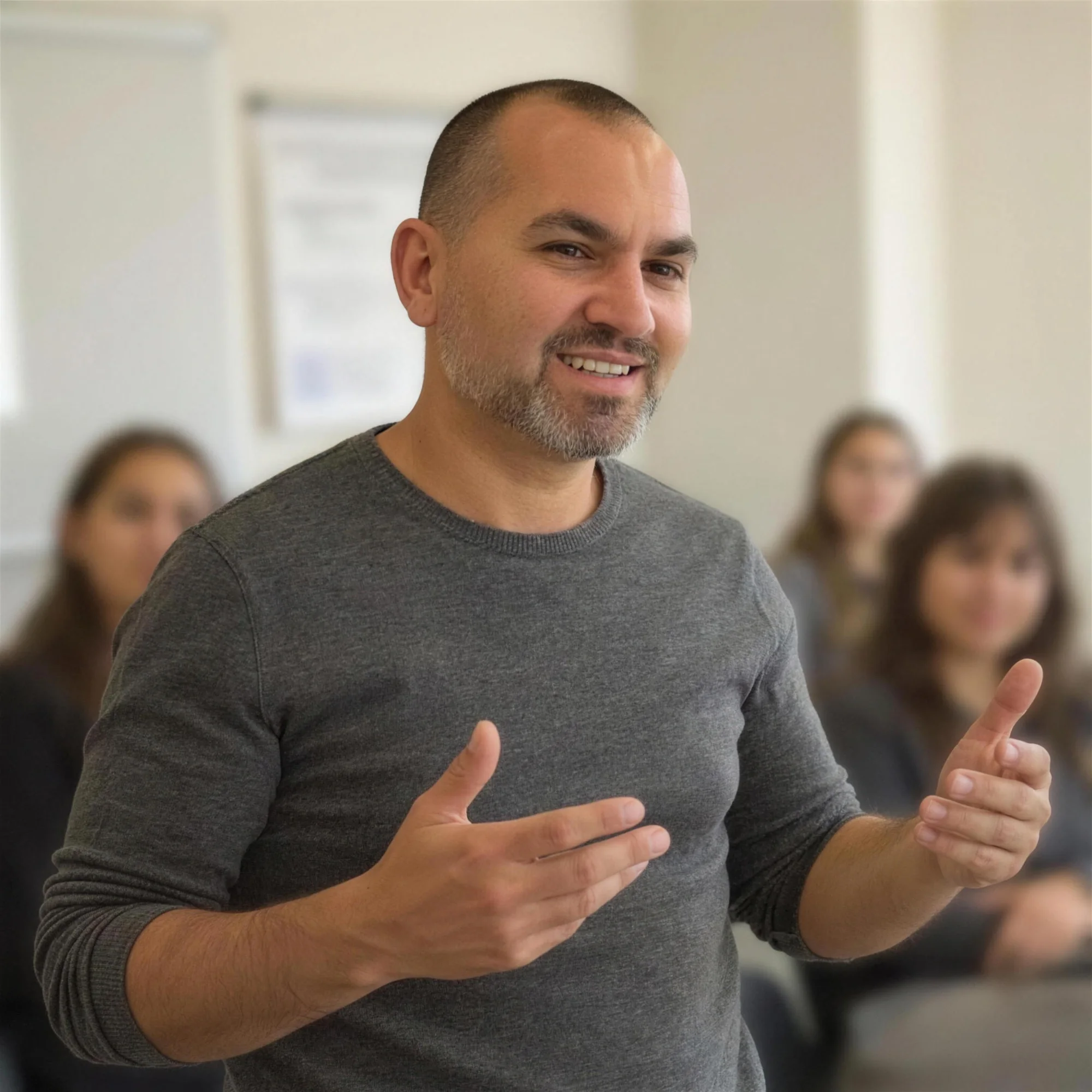
Watch Filimon unpack how this plays out in the classroom, and what changes when a student can name it. Watch here
Pressure, responsibility, and response
Pressure reveals more than knowledge.
It reveals how a young person responds when things do not go their way.
A mistake.A poor result.A hard conversation.A conflict with a friend.A moment of embarrassment.Feedback they did not want to hear.
For many young people, the issue is not only what happened.
It is what they took from it, what they decided next, and how they responded.
A student in resignation does not need another lecture about effort.
They need to see what they have already decided is not possible.
Responsibility is not about blame.
It is about helping young people see where they still have room to act.
What the work focuses on
Filimon works with schools and education environments to help young people build practical distinctions for language, responsibility, pressure, and response.
The work is not about motivation.
It is not counselling.
It is not behaviour management.
It is practical ontological work applied to how young people see themselves, speak, listen, make requests, keep promises, respond to setbacks, and take responsibility for the choices in front of them.
How the work can happen
The structure depends on the school, the students, and what the environment is dealing with.
It may involve student workshops, year group sessions, leadership groups, sports teams, or specific cohorts where the same patterns keep showing up.
Where useful, the work can also include staff-facing sessions. This matters because students are not the only ones who need language for what is happening. Teachers and school leaders also need shared distinctions for what they are seeing, how they are interpreting it, and how they respond.
The work is shaped around the school’s context, not forced into a fixed program.
The first step is to understand what students are facing, where the pressure is showing up, and what capability the school wants to build.
Who this is for
This is for schools and education environments that want students to build practical capability in how they speak, listen, respond, take responsibility, handle pressure, and relate to others.
Especially when the school wants practical work that sits outside motivation and outside clinical intervention.
Another lecture or poster on the wall is not always the answer.
Sometimes young people need better language for what they are experiencing and stronger distinctions for how they respond.
Hover a section · click to enter
Start with a conversation
If students are struggling to name what is happening, start there.
With a conversation about what they are facing, how they are responding, and what capability needs to be built. Start here.